Unified Namespace: How to Make Machine Data Centralized, Consistent, and Scalable
The pilot is up and running: one plant, a handful of machines, and data flowing. Next, the solution is to be rolled out across the entire factory network—to 500 or more machines from different manufacturers, built in various years, and equipped with different control systems. And now, the machine data needs to be made available to different users (quality engineers, maintenance technicians, data scientists, materials supply staff, etc.) simultaneously. This is where many digitalization projects get stuck. The technology is there. The problem is that each machine delivers its data in a unique way, and every new application requires its own interface.
This is where the Unified Namespace (UNS) comes in. This article explains what lies behind the architectural concept, how it works, and what components are needed for it to function effectively in everyday shop floor operations.
What problems does a Unified Namespace solve?
Conflicting figures → a common database: When MES, ERP, PLM, and analytics tools each maintain their own copies of machine data, the figures differ from one another. In the Unified Namespace, all systems access the same source. Every department and every location works with the same, consistent data.
Outdated information → real-time overview: Instead of waiting for exports or reports from the previous day, every connected system sees the current status of production. Machine status, production quantities, and malfunctions are available the moment they occur.
Complex integration → one connection per system: New software or technology is connected to the Unified Namespace once and can then access all shared data. Individual interfaces to each existing system are no longer necessary.
Unstructured raw data → foundation for predictive analytics and AI: AI applications require structured, contextualized data from all sources. The Unified Namespace provides this data in a standardized format.
What is a Unified Namespace?
Essentially, a Unified Namespace (UNS) is an event-driven architecture for structuring and orchestrating data streams for data producers and consumers in a real-time industrial operating environment. By standardizing data from different systems, data management, data exchange, and data analysis are optimized. This architecture ensures that all stakeholders across the entire enterprise can more efficiently access, integrate, and analyze key insights, leading to faster decision-making and operational agility. Instead of establishing a separate connection to the machine for each application, MES, ERP, BI tools, and AI applications all access the same source. All departments and locations work with the same data, eliminating inconsistencies and duplication. Because the architecture is open, machines and systems from different manufacturers can be integrated, and new technologies can be added later without requiring modifications.
How a Unified Namespace Works
Data flows into the UNS in three steps:
- Connecting: Machines and systems are connected via a gateway or, if they support it natively, directly via message brokers (NATS, MQTT, etc.). Common transmission technologies include OPC UA, MTConnect, Modbus, etc.
- Harmonization: The data is standardized into a uniform structure and format. Only then can other systems use it without additional effort.
- Distribution: The harmonized data is published via message brokers. Any authorized application can subscribe to it there.
Distribution thus follows the publish/subscribe principle: Data sources send data to the broker, and the broker forwards it to all recipients who have subscribed to this data. Senders and recipients are decoupled from one another. If a new application needs machine data, it simply subscribes to it. A new interface to the machine is not necessary.
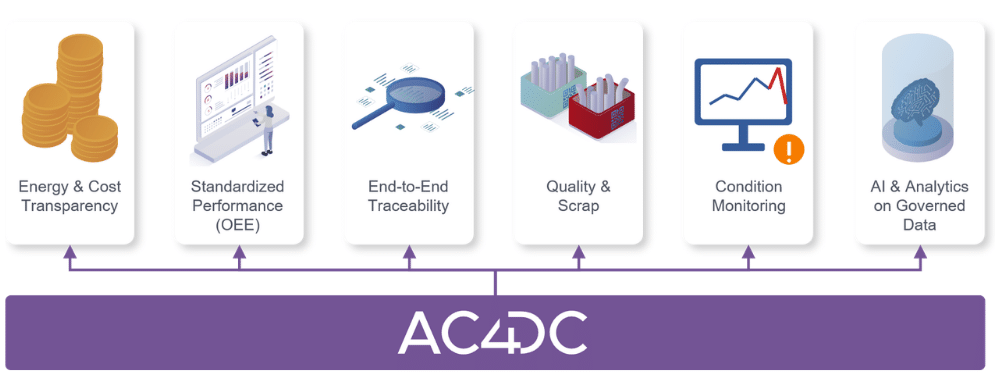
Connect once, use in many ways: The same harmonized data supports a variety of use cases—from energy and costs to OEE, traceability, quality, and scrap, all the way to predictive analytics and AI. None of these requires a separate interface to the machine. The image shows the example of AC4DC.
Why OPC UA and MQTT Alone Are Not Enough
A common misconception: Anyone who uses OPC UA or MQTT has standardized their data. However, these protocols only standardize data transmission, not the meaning of the data. A temperature value arrives intact, but the protocol does not specify whether it is in degrees Celsius or Fahrenheit, which machine it belongs to, or in which job it was generated.
The crucial step in the Unified Namespace is therefore not harmonization—that is, the contextualization of the data.
Contextualization: Giving Meaning to Data
Contextualization is critical to success. It means:
- deriving logical information from signals, such as machine status,
- annotating and converting physical units,
- assigning quantity and quality information,
- linking machine data to order information.
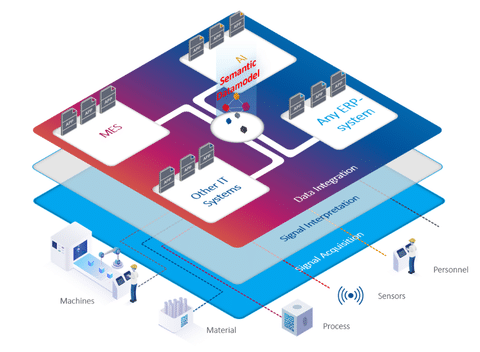
From Signal to Information: Data from machines, sensors, materials, processes, personnel, and orders is collected, interpreted, and transferred to MES, ERP, AI, and other IT systems via a unified semantic data model.
Insights can only be derived from data if it is clear what a data point describes and in what context it was generated. This is especially true for artificial intelligence: AI apps and AI reporting only deliver actionable results if the underlying data is AI-ready.
A Unified Data Model for the Entire Machine Fleet
To ensure that contextualization does not have to be performed anew for every machine, a standardized, reusable data model for the entire machine fleet is needed—a Unified Asset Data Model. Once defined, these structures are applied as templates to additional machines, lines, and locations. This creates the foundation for scalable processes on the shop floor and at the executive level and facilitates collaboration between departments—even across plants.
Modern management systems automatically generate a new version with every change. This offers three advantages:
- Traceability: It is always clear which configuration was active at any given time.
- Audit and Compliance: For standards such as ISO 9001, FDA, or IT security guidelines, it can be fully documented who made which adjustments, when, and whether they were approved.
- Risk minimization: Erroneous changes are quickly detected and reversed. This reduces downtime.
Architecture: This keeps the unified namespace stable and secure
A centralized data layer raises a valid question: What happens if it fails or is attacked? The answer lies in the architecture.
Separate data provisioning and storage. Data provisioning is handled by specialized software, while storage occurs separately, for example in databases or data lakes. If one layer is attacked, the others remain functional and production does not come to a standstill. At the same time, individual components can be replaced without jeopardizing the overall solution. This prevents vendor lock-ins.
Design shop floor IT to be resource-efficient. Production must continue even during network outages affecting higher IT levels. The following approaches have proven effective:
- Local data caching: Data is temporarily stored on-site so that nothing is lost in the event of connection problems.
- Centralized management: Administration is handled centrally, which reduces maintenance effort and personnel costs.
- Minimal resource consumption: Hardware and software require as little energy and computing power as possible.
Host large infrastructures centrally or regionally. Analytics databases do not belong on the shop floor but in central or regional hubs. This allows IT specialists to be pooled rather than maintained separately at each plant, reduces maintenance and operating costs, and makes it easy to connect new locations or production lines. Especially in regions with limited IT staff, this reduces dependence on local expertise.
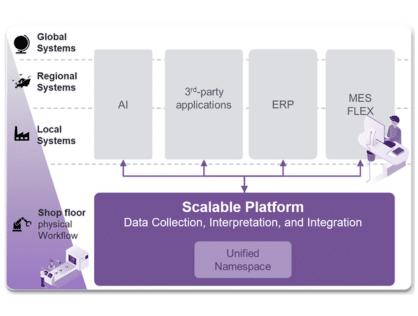
Lean on the shop floor, centralized in use: The platform collects, interprets, and integrates data close to the machine and makes it available in the Unified Namespace—for local, regional, and global systems such as MES, ERP, AI, or third-party applications. Data flows in both directions.
Centralized Management via a Control Center
With hundreds of machines across multiple locations, centralized control is essential. A Control Center handles the management of all connected machines and assets. Technologically, it is ideally based on Kubernetes and runs locally or in the cloud. Its tasks include:
- License management
- User management, including integration of external ID providers
- Certificate management
- Creating and managing gateways
- Creating and managing templates
- Connecting and managing assets
- Monitoring data streams
The advantages of the Unified Namespace at a glance
- Less integration effort: Individual interfaces are eliminated, reducing implementation and maintenance costs.
- Scalability: New machines, lines, and locations are connected using templates without fundamentally changing existing processes.
- Vendor independence: Open standards and separate IT layers prevent dependencies on individual vendors.
- Real-time data: All systems access up-to-date data and can respond more quickly.
- AI-ready: Contextualized data is a prerequisite for AI applications.
- Auditability: Versioned configurations meet compliance requirements.
What to Keep in Mind During Implementation
A Unified Namespace is not installed—it is built. Two aspects are often underestimated in this process:
Initial integration. The UNS simplifies data distribution, but the machines must first be connected and their data harmonized. With heterogeneous machine fleets in the OT domain, this is the most time-consuming part.
The limitations of in-house solutions. Many teams start with low-code or no-code solutions and achieve good results for individual assets. However, when rolling out to the factory network, it often becomes apparent that the in-house solution lacks flexibility, becomes confusing as complexity increases, and is barely scalable or maintainable. The make-or-buy decision should therefore not be based solely on short-term costs, but on long-term requirements for scalability, security, maintainability, and compliance.
As a general rule, the more systems and machines a company has, the greater the benefit of a unified namespace.
Build a Unified Namespace – Without In-House Development
AC4DC is FORCAM ENISCO’s industrial data management platform. It connects heterogeneous machine fleets, contextualizes the data, and makes it available in the Unified Namespace for MES, ERP, and AI applications—scalable from a single plant to an entire factory network.
Conclusion
The Unified Namespace solves a fundamental problem in digital manufacturing: data that is collected but cannot be used consistently. What matters most here is not so much the protocol itself as what lies above it: a unified, contextualized data model; an architecture with separate IT and integration layers; and centralized management that scales with the machine fleet. Those who incorporate these building blocks from the outset will create a production IT system that can be scaled from a pilot plant to the entire factory network and is ready for AI applications.