Industrial Data Management: How Production Data Contributes to ROI
Modern factories hold production data in large volumes. But technically available is not the same as consistently usable. Different machine generations, controllers, sensors and communication protocols mean that data often arrives in different structures and contexts.
This is exactly where industrial data management comes in. Production data is collected as close to its source as possible, then normalized, structured semantically and contextualized. Individual signals become a reliable data foundation that many applications can use — OEE, quality management, traceability, maintenance, energy management, analytics and AI.
The economic benefit does not come from better data availability alone. A standardized and reusable data infrastructure can reduce integration effort, bring new use cases live faster and support scaling across machines, lines and plants.
So the decisive question is: how do existing production data become information you can use permanently?
Why production data is often not consistently usable
In real production environments, machines of different generations, proprietary controllers, sensors and various communication protocols come together. The data is technically available, but frequently not in a consistent, usable form.
A production signal on its own is not reliable information. It only becomes usable once you know what the signal means, which machine it came from, which process it belongs to and in which production context it was created.
From raw signal to contextualized production data
Industrial data management should therefore collect and prepare data where it is created — as close as possible to the machine or another data source.
When production data is normalized, structured semantically and contextualized at its source, it forms a reliable data foundation for key figures and use cases such as OEE, quality management, traceability, maintenance, energy management, analytics and AI.
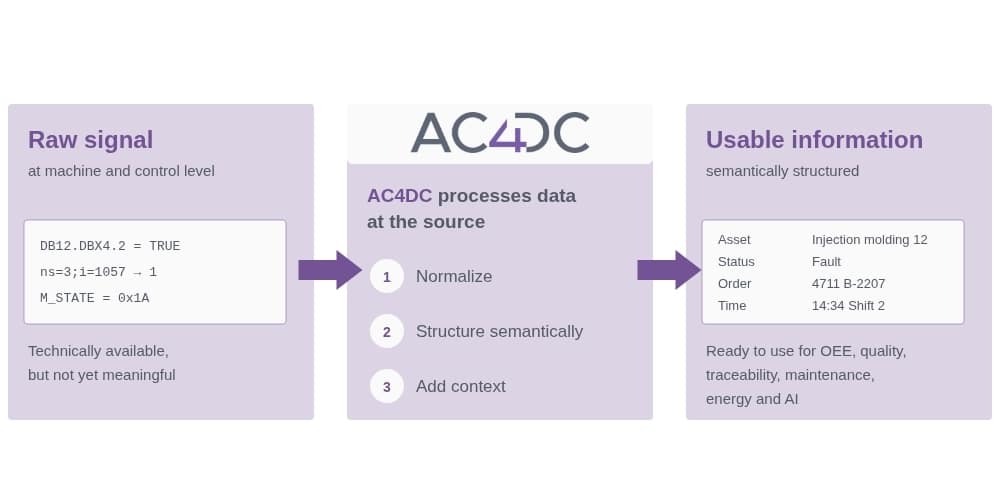
Modern industrial data management therefore offers far more than connectivity and pure data collection. It creates a scalable and reusable data infrastructure.
AC4DC: a scalable data platform right at the source
This is exactly the task AC4DC from FORCAM ENISCO takes on.
The platform connects machines, controllers and other data sources and transfers their data into a consistent, semantically understandable structure. Production data is normalized and enriched with the necessary context right where it is created.
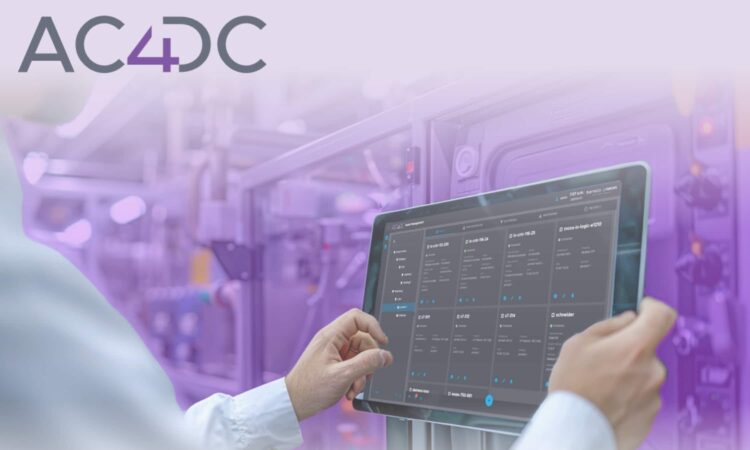
The decisive advantage: the data is not prepared for one single use case only. It is then available as a standardized data foundation for different systems and applications. The same data infrastructure can supply MES, ERP, LIMS, analytics or AI applications.
Make production data usable in a standardized way
Find out how AC4DC structures and contextualizes production data from different sources and makes it available to various systems and applications.
Why point-to-point connections make scaling difficult
Companies know the problem: a digitalization project starts with one specific use case. A machine is connected, data is transferred through an interface and then prepared for one particular application.
With the next use case, a similar project starts all over again.
Every additional application creates more point-to-point connections, individual data models and dependencies. The system landscape grows more complex, while integration effort and technical debt increase.
Industrial data management therefore takes a different approach: not a new data integration for every application, but one standardized data foundation that can be used many times over.
Standardized structures and reusable templates make it faster to connect additional machines, lines and plants. A data foundation built once no longer has to be implemented again for every further use case.
That lowers the effort for additional applications and production areas and at the same time increases the value of the existing infrastructure.
5 ways industrial data management can cut costs and improve ROI
The monetary benefit of a modern data architecture comes down to several levers.
1. Reduce integration costs
Standardized data models and reusable templates reduce the effort of connecting new machines, lines and plants. Instead of developing individual point-to-point interfaces for every use case, a shared data foundation is created.
This can lower project effort and reduce long-term technical complexity at the same time.
2. Lower operating costs
Contextualized production data makes deviations and faults visible faster. That can help reduce unplanned downtime, plan maintenance better and cut manual effort.
There are savings on the administrative side too: fewer media breaks, fewer manual Excel workarounds and less effort for reporting and data preparation reduce indirect operating costs.
3. Increase production output
Production processes become more transparent, more stable and easier to control when relevant data is available in real time and in a consistent context.
OEE optimization, condition monitoring, faster fault detection and scrap avoidance are therefore not only technical use cases. They can pay directly into productivity and production costs.
Even small improvements in scrap and unplanned downtime can create considerable economic effects, depending on production volume and value added.
4. Shorten time-to-value
When machines and production data are already accessible through a standardized data infrastructure, new use cases can be implemented faster. Measurable business impact can be reached earlier.
The sooner a use case goes live, the sooner it can create economic value — and pay into ROI.
5. Scale across lines and plants
The biggest structural economic effect comes from reuse.
When the same data infrastructure with the same templates is used for further lines or plants, the marginal cost of each additional use case falls. The investment in industrial data management does not stay a one-off solution for a single production line; it becomes a scalable infrastructure.
How reusability shapes the ROI of a data platform
The ROI of an industrial data platform rarely comes from a single use case. It comes from the combination of several economic effects: less integration effort, lower operating costs, higher production performance and faster implementation of new applications.
It is worth distinguishing between short-term and structural ROI.
In the short term, transparency, OEE, traceability, alerting or condition monitoring can create measurable benefit. In the medium and long term, the biggest effects come from standardization, reuse and governance.
Because every additional use case, every additional line and every additional plant can build on the data foundation already in place.
The investment therefore pays not only into the first use case, but into all those that follow. A single IT project becomes a scalable value creation platform.
Why contextualized production data matters for AI
With the use of AI, this architecture becomes even more important.
AI applications can analyze large volumes of data. Their results, however, depend directly on the quality and the context of the underlying data. Production data that is technically available but inconsistent in meaning cannot form a reliable basis for intelligent analysis.
So the rule is: the more intelligent the application, the more important the quality of the data foundation.
Semantically structured and contextualized production data creates the conditions for analytics and AI applications to recognize relationships reliably and to combine information from different sources in a meaningful way.
Industrial data management therefore becomes an important building block of an AI-ready factory.
Conclusion: industrial data management creates a reusable data foundation
Industrial data management is far more than an IT topic. A consistent and contextualized data foundation can support productivity, quality, scalability and the implementation of new applications.
What matters is structuring and contextualizing production data semantically at its source. AC4DC creates the technical basis for this and makes the resulting data foundation available to MES, ERP, analytics and AI.
The economic benefit comes from the combination of lower integration and operating effort, higher production performance, faster time-to-value and reuse across further machines, lines, applications and plants.
The value of industrial data management therefore arises above all where production data can be used not just once, but permanently and for different applications.
What could a reusable data foundation look like in your production?
Find out more about how AC4DC makes production data available to MES, ERP, analytics and AI. → Learn more about AC4DC