

Time and Attendance Tracking with MES FLEX: Record Working Hours by Order
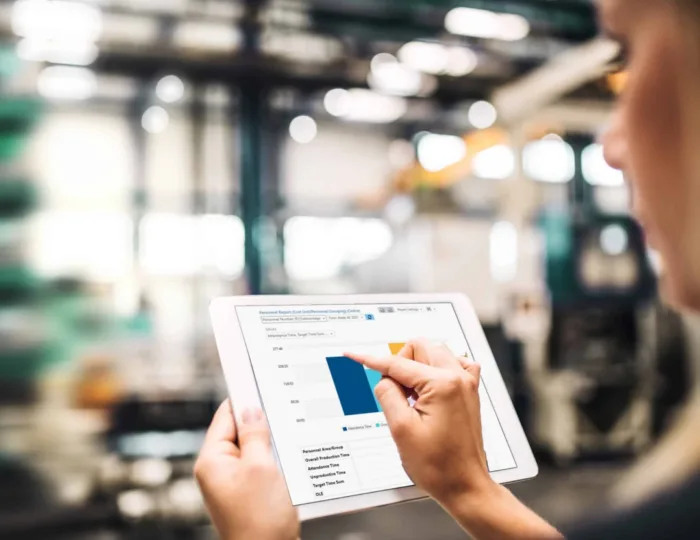
How many employees worked on which product, and for how long—whether as scheduled or unscheduled? With the Time and Attendance Tracking app in MES FLEX, you can answer these questions at the touch of a button and calculate unit costs based on actual labor hours.
In addition to machine data, labor hours are the decisive factor for precise schedules and costs. Unit costs can only be calculated accurately if the ERP system has all production parameters. MES FLEX links labor hours directly to production orders, machines, and processes—digitally, without timesheets and without duplicate entries.
Time Tracking as a Management Tool
- Employees log their hours directly at their workstations for current projects
- The times are immediately linked to machine and process data
- This eliminates duplicate entries and data entry errors
- Managers see variances between planned and actual figures in real time and can respond immediately
The Time Tracking App
-
Book time slots right where they arise
Employees accurately log their time: job, work activity, and material; internal jobs; cost centers; attendance; workstation; and machinve
-
Flexible Data Entry
Your employees can record their attendance directly at their workstations using the standard MES FLEX terminal. You can integrate existing time-tracking systems via the web interface (API)
-
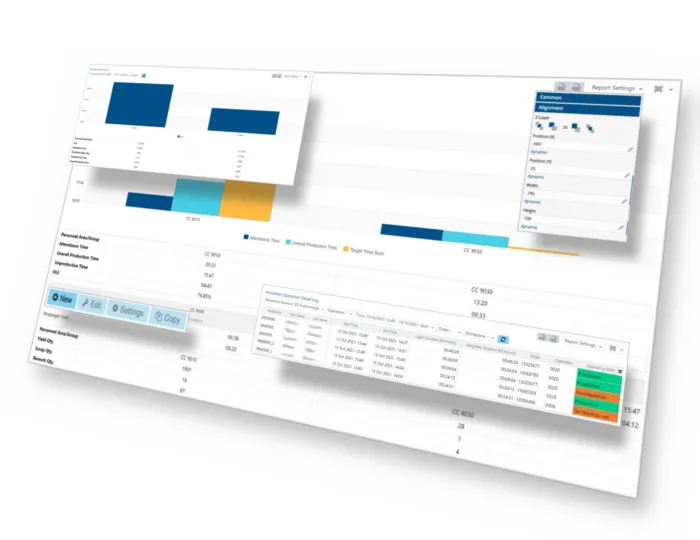
Analyze in Integrated Reporting
All personnel time data is available for analysis in MES FLEX reporting and is aggregated in the ERP system
Transparency and Key Metrics from Personnel Times
Personnel Times support product genealogy as well as your lean management initiatives—and provide reliable metrics for planning and costing.
Full transparency across all activities
- Times are assigned to production orders, machines, cost centers, or workstations
- Even secondary activities such as setup, maintenance, cleaning, or quality inspection are recorded
- You can view productive, unproductive, and hidden times
- The combined view of people and machines enables precise root cause analysis
OEE, Productivity, and Unit Costs
- Labor hours are factored into the calculation of Overall Equipment Effectiveness (OEE)
- Target-to-actual comparisons improve your planning and standard times
- The working time per order or batch enables an exact calculation of unit costs
- Integrated into dashboards, the data fosters a data-driven culture of improvement
The Benefits of Employee Time Tracking
- Full transparency regarding employee assignments
- Accurate allocation of personnel costs in management accounting
- Optimized workforce scheduling and greater planning accuracy
- Reduced administrative burden and legally compliant working time documentation
- Up-to-date working time accounts and complete attendance tracking
Implementing Employee Time Tracking Correctly
Employee time tracking is a sensitive topic. A good guiding principle is the formula “Value Creation Through Appreciation.”
Communicate openly
Explain the reasons, how it works, and the rules before implementation, and involve the workforce.
Make data usage transparent
Show what the data is used for—such as payroll, planning, or cost estimation.
Ensure Data Protection
Data processing must comply with legal requirements, particularly the GDPR.
Grant Access
Employees can view their recorded data at any time and request corrections.
What is employee time tracking?
Employee time tracking is the systematic recording of employees’ working hours. It forms the basis for payroll processing, documents compliance with legal requirements, and provides data for planning personnel, projects, and costs. Digital systems replace timesheets and punch cards, which are inaccurate, prone to errors, and time-consuming to analyze.

Frequently Asked Questions About Employee Time Tracking
How does time tracking in MES differ from traditional time tracking?
Traditional time tracking primarily records attendance. In MES, working hours are also linked to orders, work steps, and machines. This generates data for unit costs, OEE, and planning times.
Can I continue to use my existing time tracking system?
Yes. External time tracking systems can be integrated via the MES FLEX web interface (API).
What can employees track their time against?
Orders, work processes, and materials; internal orders; cost centers; attendance; as well as workstations and machines.
How does employee time tracking help with unit cost calculation?
MES FLEX shows how many employees worked on a product and for how long. These employee time records are available in aggregated form in the ERP system, making it possible to accurately calculate labor costs per product.

Know exactly what your labor costs are per product
In a demo, we’ll show you how time tracking works in MES FLEX at the workstation and what reports you can generate from it.
Knowledge, Events, and Case Studies on MES FLEX
The latest technical articles, webinars, and success stories on digital manufacturing with MES FLEX.

Keine Inhalte gefunden.
