Production planning in manufacturing – planning levels explained simply
Efficient production planning in manufacturing is a key success factor for modern industrial companies.
Machinery, staff, materials and orders must be coordinated in such a way that delivery deadlines are met, capacity is utilised optimally and production costs are kept under control.
However, production planning does not consist of a single plan. In practice, companies work with several planning levels, which differ primarily in terms of their time horizon and level of detail.
Whilst long-term planning supports strategic decisions, operational production planning and control ensure that day-to-day production actually runs smoothly.
In this article, you will learn:
- what planning levels exist in manufacturing,
- what role ERP, MES and other software systems play, and
- why detailed planning is becoming increasingly important for modern production.
What are the planning levels in production planning?
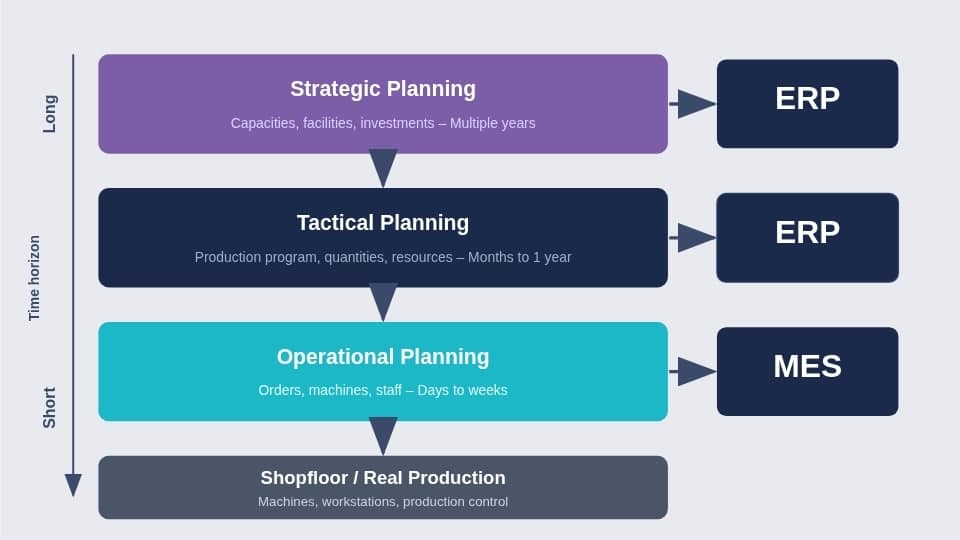
Planning in a production environment consists of three key planning levels:
Strategic planning: long-term planning of capacities, production facilities and investments (several years)
Tactical planning: medium-term planning of the production programme, quantities and resources (months to one year)
Operational planning: short-term detailed planning of orders, machines, workstations and personnel (days to weeks)
Whilst an ERP (Enterprise Resource Planning) system usually supports strategic and tactical planning, operational fine-tuning is often carried out via an MES (Manufacturing Execution System).
An MES system links the planning level of the ERP with actual production and ensures precise production control on the shop floor.
Strategic production planning (long-term planning)
Strategic production planning covers periods of several years and defines the fundamental direction of production.
Typical topics at this planning level include:
- Investments in machinery and production facilities
- Establishment of new production sites
- Long-term capacity planning
- Technology decisions
- Development of new production lines and products
These decisions often influence the structure of a production system for many years to come.
That is why this planning is frequently based on market forecasts, scenario analyses and long-term corporate objectives.
Tactical production planning (medium-term planning)
Tactical planning usually covers a period ranging from several months to a year.
Typical examples include:
- Annual planning
- Quarterly planning
- Planning of production volumes
- Planning of materials and resources
In this phase, the following is determined:
- which products are to be manufactured
- what capacities are required
- how production schedules are spread throughout the year
Many companies carry out this planning in their ERP system.
ERP systems are particularly good at processing large volumes of data. For example, they manage:
- parts lists
- work plans
- Planned orders
- Production orders
- Materials and stock levels
However, to make this complexity manageable, ERP systems often employ simplifications.
A typical assumption is planning with infinite capacity.
But anyone responsible for production knows that such capacities do not exist in reality.
Operational production planning (short-term planning)
Operational production planning and control focuses on the short-term production period.
Typically, it covers:
- one to two weeks in detail
- up to three months in the forecast
Specific decisions are made regarding:
- which machine processes which order
- the order in which work steps are carried out
- which employees are deployed
- how bottlenecks are avoided
This planning is often supported by a Manufacturing Execution System (MES).
The MES ensures detailed production control by taking real-time production conditions into account.
What is detailed planning in production?
Detailed planning – also known as detailed scheduling – translates the rough planning from the ERP into a production plan that can be realistically implemented.
This takes real production conditions into account, for example:
- Machine capacities
- Staff availability
- Shift patterns
- Set-up times
- Delivery dates
The aim of detailed planning is not necessarily a mathematically perfect plan.
Far more important is a feasible plan that can be implemented under real-world conditions.
Schedule4SF: Detailed planning for flexible and realistic production
To turn a theoretical plan into a production plan that can be realistically implemented, systems are needed that take real-world conditions on the shop floor into account.
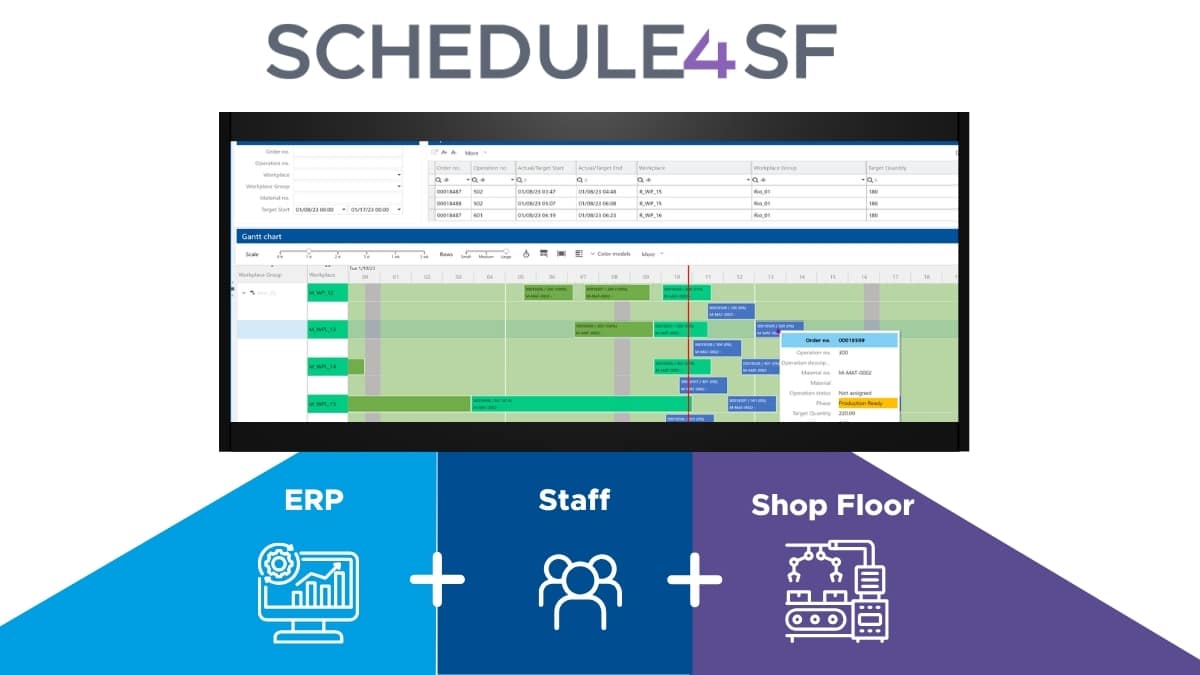
With Schedule4SF (Schedule for Shop Floor), FORCAM ENISCO provides a solution for operational detailed planning that helps manufacturing companies make their planning significantly more precise and flexible.
Schedule4SF makes it possible to incorporate real production conditions into the planning – such as machine availability, staff capacity or current order volumes. This results in production plans that can actually be implemented.
With Schedule4SF, companies benefit from, among other things:
- realistic detailed planning directly for the shop floor
- better utilisation of existing capacities
- greater transparency regarding orders and production processes
- faster response to bottlenecks or deviations from plan
Find out how Schedule4SF can optimise your production planning
Capacity planning as the core of detailed planning
Capacity planning is the central component of any detailed planning.
Several factors must be taken into account simultaneously:
- available machinery
- available staff
- available resources
- planned production orders
An important part of capacity planning is also taking actual availability into account.
Planning machines realistically
Machines form the backbone of any production facility.
However, in reality, machines are never available for their full scheduled duration.
Realistic capacity planning must therefore take the following into account:
- Maintenance times
- Breakdowns
- Reduced performance
- Breaks during shifts
In many production environments, actual machine availability is only 60 to 80 per cent.
These figures can be determined via machine data collection and OEE metrics and integrated directly into detailed planning.
People in production planning
Alongside machines, people remain the central dimension of production planning.
Even in highly automated production systems, the following applies:
A machine can only operate if a qualified employee is available.
Therefore, the following factors must also be taken into account in capacity planning:
- Employee qualifications
- Available shifts
- Workstations
- Staff capacity
Only by combining machine capacity and staff availability can a realistic production plan be drawn up.
Orders and deadlines as the framework for planning
Most production orders are created in the ERP system.
Two important dates are set there:
Earliest start date
This date defines when an order can begin – for example, when materials are available.
Latest finish date
This date corresponds to the customer’s desired delivery date.
The scope for optimisation in production planning lies between these two key dates.
ERP, MES and production planning and control
In modern production environments, several systems work together.
ERP system
The ERP is primarily responsible for:
Production Requirements Planning
Material planning
Order management
Commercial processes
High-level planning
MES system
The MES, on the other hand, handles:
Operational detailed planning
Production control
Data acquisition from machines
Production visualisation
Support for production control
Put simply:
ERP plans – MES ensures that the plan works.
Production board and visualisation of production
An important tool for operational production planning is the planning board.
The planning board visualises:
Production orders
Machine allocation
Scheduling
Capacities
Thanks to the graphical display, planners can immediately identify:
Bottlenecks
Available capacity
Deviations from plan
This transparency facilitates decision-making in day-to-day production management.
Production planning and control in day-to-day operations
Operational production planning and control is a continuous process.
Even if a production plan has been drawn up, reality can deviate from it at any time.
Typical causes include:
Machine breakdowns
Material issues
Staff shortages
That is why planning processes need to be regularly adjusted.
However, it is important not to replan every minor change immediately, as this would lead to unstable plans.
Advantages of modern production planning
Modern production planning and control offers companies numerous advantages:
- greater on-time delivery
- better capacity utilisation
- more efficient use of resources
- shorter downtime
- better decision-making in controlling
Above all, the combination of ERP, MES, software tools and detailed planning enables flexible control of complex production processes.
Conclusion – Production planning is becoming a central component of the smart factory
Production planning in manufacturing consists of several levels:
Strategic planning
Long-term decisions regarding production facilities, technologies and capacities.
Tactical planning
Medium-term planning of production volumes, materials and resources.
Operational planning
Short-term detailed planning of machinery, staff and production orders.
Operational production planning and control, in particular, are becoming increasingly important.
Increasing product variety, smaller batch sizes and shorter lead times require flexible planning systems.
Companies that support their planning with MES software and modern planning board systems benefit from:
- higher capacity utilisation
- better production control
- greater transparency in production
- more stable production processes
Would you like to improve your detailed planning and make your production planning more flexible?
Find out more about Schedule4SF and how you can take your production planning to the next level