


AC4DC in Action
Industrial Data Management Platform in Practice
See how AC4DC integrates, contextualizes and delivers industrial data for different systems and applications.


AC4DC – Industrial Data Management Starts with Semantics and Context
Today, production departments have more data at their disposal than ever before.
ERP, MES, EAM, SCM, analytics and AI all require the same information – but in different contexts. The problem here is not the availability of data, but the lack of data integration on a shared production data platform.
Data alone does not create understanding.
What’s missing is uniform semantics and a shared context that makes data interpretable consistently across system boundaries.
Different perspectives on the same information hinder transparency, scalability and the efficient use of data in digital business processes. This can be avoided by integrating data on a single data platform.

AC4DC creates a common semantic data foundation for scalable industrial data management.
The platform connects assets, systems, and applications via a common technical and domain-specific foundation. Data is not merely transferred, but placed within a shared context and made usable for various use cases.
This creates a shared context for industrial data—regardless of systems, locations, or use cases.
See how AC4DC integrates, contextualizes and delivers industrial data for different systems and applications.
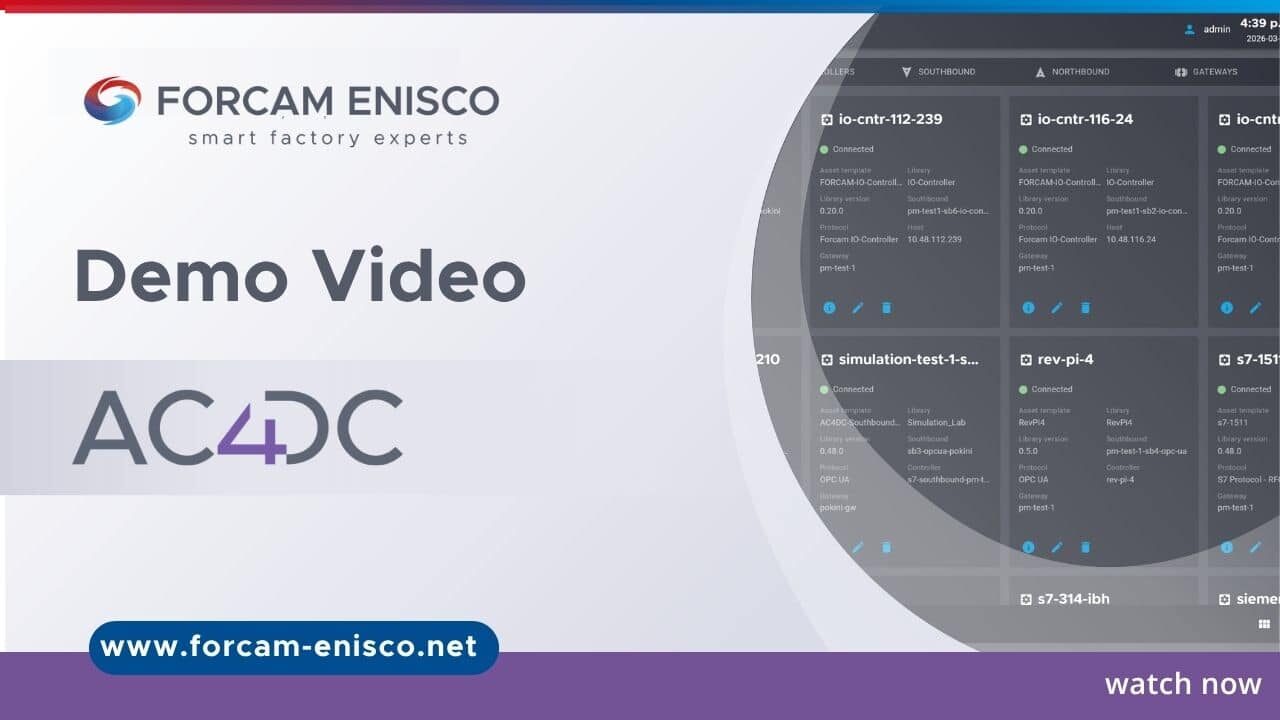

Digitalization rarely fails because of the data—but rather because of a lack of structure and scalability on the shop floor. Industrial data management therefore does not begin with additional interfaces, but with a shared understanding of data.
This requires:
The challenge facing modern industrial companies is not to create additional integrations. Rather, the key is to make data consistently usable across system boundaries.
Data is often available only to a single system; every additional interface increases effort and risk. Raw signals without context are useless for AI and analytics.
Hardware, maintenance, and documentation costs recur repeatedly. Without systematic management of templates, versions, and rollouts, changes are virtually impossible to reproduce.
In-house developments rely on the knowledge of individuals and reach their limits when scaling up. Without complete traceability, it is difficult to substantiate audit findings.
A scalable data architecture is transforming the logic of industrial digitalization: Instead of having to integrate data anew for every new use case, a common foundation is created that can be reused.
Point-to-point seems cheap at first — but every interface raises cost and risk. A semantic data layer flips that logic: every new use case uses the same foundation.
AI apps and AI reporting need contextualized and semantically consistent data. Whoever creates the data foundation also creates the prerequisite for scalable AI applications.
Common rules, structures, and responsibilities ensure consistent, trustworthy, and traceable data.
The decision shouldn’t rest on short-term costs alone, but on long-term requirements for scalability, security, maintainability and compliance. Standardized solutions offer sustainable investment security through regular updates and support.

The AC4DC platform, with its integrated 4SF packages (Connectivity, Quality, Solve and Inventory) provide a shared, centrally managed data foundation for various industrial use cases.

AC4DC creates a common data foundation between the shop floor and IT systems. The platform connects assets and IT systems, structures and interprets data, and makes it available as a common, standardized data model.
This enables:
Find out how gateways, the semantic layer and data provisioning interact within the AC4DC platform.
Explore Platform & Architecture in Detail >
Book a live technical demo and find out how AC4DC can be integrated into your specific IT/OT environment.
You are currently seeing a placeholder content of Microsoft Dynamics CRM. To access the actual content, click on the button below. Please note that data will be passed on to third-party providers.
More information
10 Clear Answers on Data, Processes, and Performance—a concise guide for decision-makers who want to take corrective action.